
Water heater expansion tanks and T&P relief valves: when you need them and how to check them
Affiliate disclosure: HVACDirect is an affiliate partner. Product links below use our affiliate tracking and may earn a commission at no extra cost to you. We have not hands-on tested these products; specs and prices are from HVACDirect's own product pages as of November 12, 2026. See our affiliate disclosure.
Last reviewed: November 12, 2026.
- If your home has a check valve, backflow preventer or pressure-reducing valve on the main, heated water has nowhere to go. The model code (IRC) then requires a way to control that pressure, usually a thermal expansion tank.
- Set the tank's air pre-charge to match your house water pressure before you install it.
- Test the T&P relief valve once a year. If it drips now and then, thermal expansion is a common cause. Never plug or cap it.
Every tank water heater has two small safety parts most people never look at: the brass temperature-and-pressure (T&P) relief valve on the side or top, and, in many homes, a small expansion tank on the cold line. Both are inexpensive and often DIY-friendly to replace. Here's what each one does, how to tell if you need one, and how to check them.
1. Why heated water needs somewhere to go
Water expands as it heats. In older plumbing, that extra volume could push back into the city main. Many homes now have a check valve, backflow preventer or pressure-reducing valve (PRV) at the meter or main, which makes the plumbing a closed system. In a closed system, each heating cycle raises the pressure in the whole house.
- The 2021 International Residential Code (IRC) section P2903.4.2 says that where a backflow preventer, check valve or similar device is installed on a system with a storage water heater "such that thermal expansion causes an increase in pressure," a device for controlling pressure shall be installed.
- P2903.4.1 requires the same where thermal expansion pushes pressure above a PRV's setting.
- Separately, P2903.3.2 caps static house pressure at 80 psi. Above that, a pressure-reducing valve is required.
Local codes vary, so check with your city or county. Many adopt the IRC with amendments.
2. Signs you may have a thermal expansion problem
- The T&P valve drips or spits water now and then, often after the heater has run. Rheem's water heater manuals note that periodic relief valve discharge "may be due to thermal expansion in a closed water system."
- A pressure gauge on a hose bib reads normal in the morning but climbs while the heater runs.
- You have a PRV, a check valve, or a meter with a built-in check, and no expansion tank on the cold line.
An inexpensive hose-bib pressure gauge (the kind that screws onto an outdoor faucet) lets you check static pressure yourself. Some versions have a "max" needle that records the highest reading overnight.
3. How a thermal expansion tank works
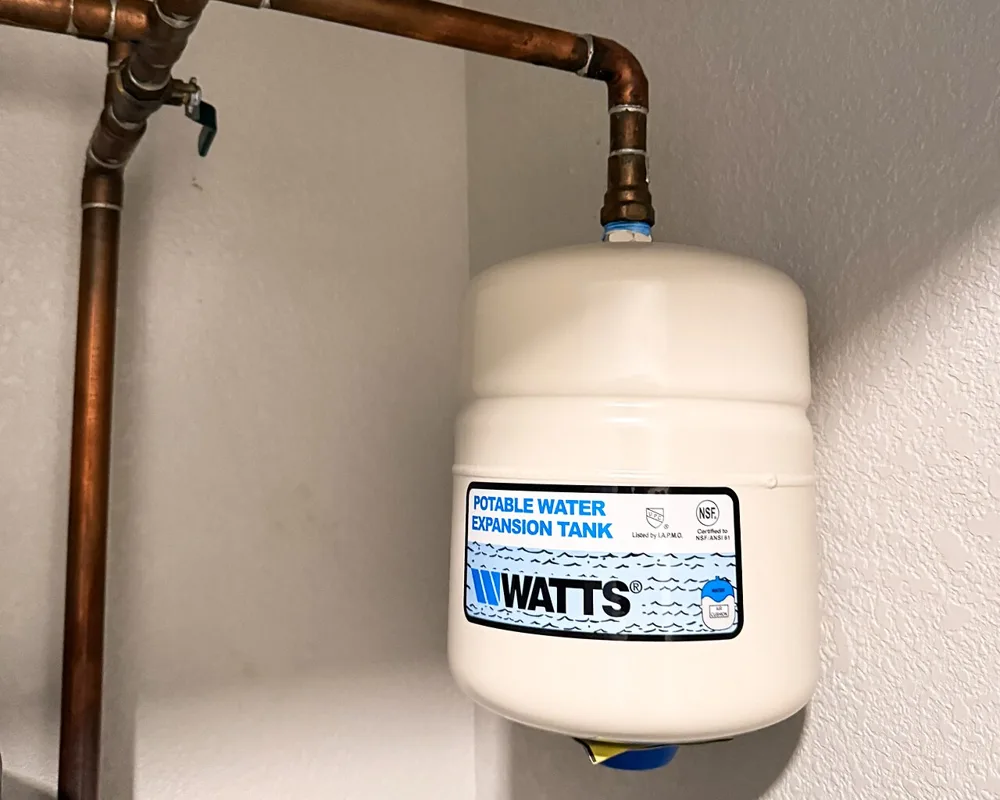
A thermal expansion tank is a small steel tank split inside by a rubber diaphragm or bladder. One side holds pressurized air, and the other connects to your cold water line. As heated water expands, the extra volume pushes into the tank and squeezes the air cushion, so house pressure rises far less. When you use hot water, the air pushes that water back out.
- Use a potable-water tank. Hydronic (boiler) expansion tanks are a different product. Look for wording such as "potable" or "thermal expansion" and NSF/ANSI 61 listing.
- Where it goes: on the cold supply to the water heater, between the heater and the backflow device or check valve. Amtrol's instructions say this, and so do Watts'.
- Mounting: Amtrol recommends water connection up (tank hanging below the pipe). Other positions are allowed only if the tank body is fully supported. A filled tank is heavy, so brace the pipe if needed.
4. Set the air pre-charge first (the step most people skip)
Expansion tanks ship with a factory air charge. Amtrol's standard Therm-X-Trol ships at 40 psi, and the Everbilt tank below is listed as pre-charged to 40 psi. Your house may be higher or lower. Both Amtrol and Watts say to match the air pre-charge to your incoming water pressure before installation, with the tank empty.
- Measure house pressure with a gauge (open and close a faucet first so the reading settles).
- With the tank still in the box or off the system, check the air valve with a tire gauge.
- Add air with a hand bicycle pump or let some out until it matches. Watts says not to go above 80 psi and not to adjust the charge with the tank under water pressure.
- Replace the air valve cap. Amtrol warns that a poorly sealed cap can lose the charge and make the tank fail.
Why it matters: Watts' own chart for its PLT-5 tank shows how much expanded water it can accept falling from 1.26 gallons at a 40 psi pre-charge to 0.80 gallons at 80 psi. If the air charge is lower than house pressure, city water fills part of the tank before the heater even starts, which wastes capacity. Use the tank maker's sizing chart (heater gallons and your water pressure) to pick the size.
5. The T&P relief valve: your last line of defense
IRC P2804.1 requires every water heater to have relief protection, usually a combination temperature-and-pressure relief valve. It opens if tank temperature or pressure gets too high.
- Test it yearly. Rheem's manuals say to lift and release the test lever at least once a year so the valve operates freely, and to let water flush through the discharge line to an open drain. Hot water comes out, so keep hands and feet clear.
- Replace it if it won't open, keeps dripping after the test, or is crusted with scale. Rheem's valve sheet says repair or alteration of the valve is prohibited by national safety standards, so replace it instead.
- Match the rating. Rheem's manuals say the valve's pressure rating must not exceed 150 psi or the tank's marked working pressure. Its BTU/hr rating must equal or exceed the heater's input on the rating plate.
- Never plug, cap or valve it off. IRC P2804.6 forbids any shutoff or check valve between the relief valve and the tank or in the discharge pipe.
6. Discharge pipe rules worth checking
A quick look at the pipe running down from your T&P valve can catch common mistakes. Under IRC P2804.6.1, the discharge pipe should:
- Be no smaller than the valve outlet and serve only that one valve
- Run downhill by gravity, with no traps or dips
- End in the same room, at the floor, the drain pan, a waste receptor or outdoors, where you can see it
- End no more than 6 inches above the floor or receptor rim, with no thread on the end
While you're there: IRC P2801.6 requires a drain pan under tank heaters where a leak would cause damage, and P2903.9.2 requires an accessible full-open shutoff valve on the heater's cold supply.
Two water heater parts under $45 (HVACDirect)
Prices were checked on hvacdirect.com on November 12, 2026 and change often. Coupon code TBZOQ3JUBY0G may take a small amount off; confirm at checkout.
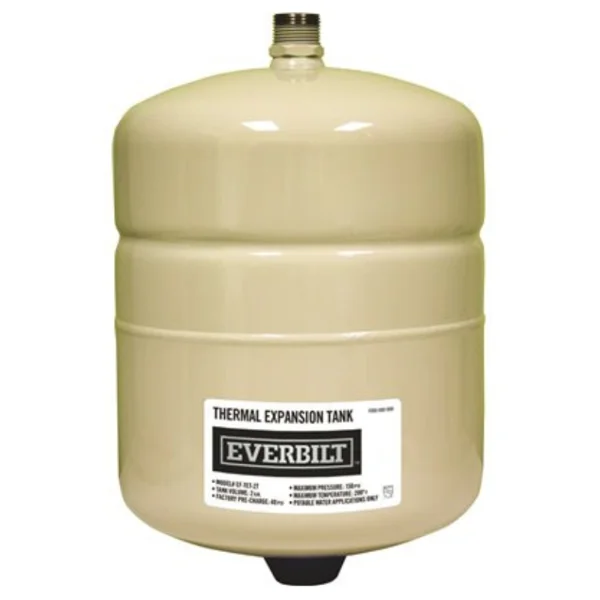
Everbilt 2 Gallon Thermal Expansion Tank
$42.99
Butyl diaphragm, 3/4-inch connection, factory pre-charged to 40 psi, 150 psi rating (per HVACDirect). A 2-gallon size for typical home heaters; check the sizing chart for yours.
View on HVACDirectCode TBZOQ3JUBY0G
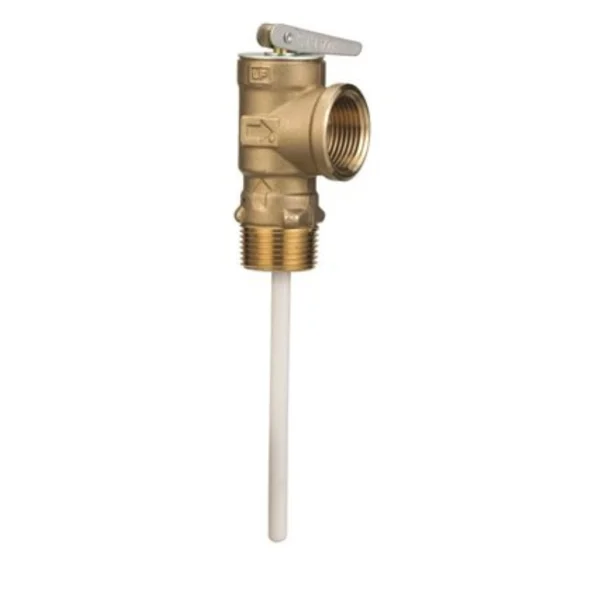
3/4 Inch Temperature and Pressure Relief Valve
$31.11
Brass, ASME-rated and CSA-listed, 210°F temperature relief, 150 psi max, for heaters up to 105,000 BTU/hr (per HVACDirect). Includes a test lever. Check your heater's rating plate first.
View on HVACDirectCode TBZOQ3JUBY0G
HVACDirect links above are affiliate links. HVACDirect also lists a 4.5-gallon Everbilt tank for larger heaters or higher pressure; see the Products page.
DIY or call a plumber?
- Usually DIY-friendly: testing the T&P valve, checking pressure with a gauge, setting a tank's pre-charge, and adding an expansion tank where a tee or fitting is already in place.
- Take extra care: replacing a T&P valve means shutting off the gas or power and cold water, then draining some water below the valve opening. Use thread sealant rated for potable water and hot water.
- Call a pro: if pressure is above 80 psi (you may need a PRV), the tank tapping is corroded, you smell gas, or local rules require a permit for water heater work.
Bottom line
If you have a closed system and no expansion tank, a periodically dripping relief valve is your house asking for one. Match the tank's air charge to your water pressure, mount it on the cold line, and test the T&P valve every year. Two parts that cost under $75 together protect a heater that costs far more.
Related: automatic water shutoff valves and leak detectors, hard water and tankless water heaters, and push-fit shutoff valve replacement.
Sources
- 2021 IRC Chapter 29 (via UpCodes): P2903.3.2 (80 psi maximum), P2903.4 thermal expansion control, P2903.9.2 water heater valve
- 2021 IRC Chapter 28 (via UpCodes): P2801.6 required pan, P2804 relief valves and discharge pipe rules
- Watts PLT-5/12/20 potable expansion tank instructions (pre-charge to system pressure, 80 psi limit, acceptance vs pre-charge table)
- Amtrol thermal expansion tank installation instructions and Amtrol Therm-X-Trol sizing guide (placement, mounting, 40 psi factory charge, matching pre-charge)
- Rheem water heater use and care manual (annual relief valve test, thermal expansion notice)
- Rheem T&P relief valve instruction sheet (installation, yearly operation, no repair or alteration)
- HVACDirect product pages for the Everbilt 2-gallon tank and 3/4-inch T&P valve: specs and prices (checked November 12, 2026)
Information only; not plumbing advice. Follow your water heater's manual and local plumbing code, turn off gas or power before service, and hire a licensed plumber when in doubt.