
Garage door opener with battery backup: buying guide
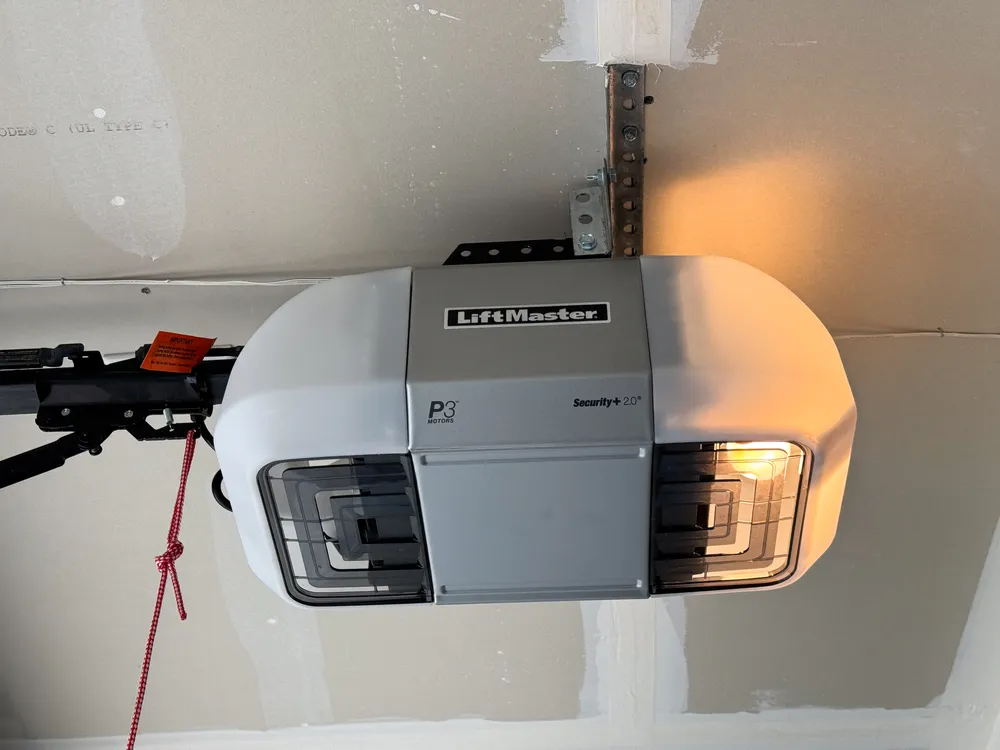
Affiliate disclosure: Product links below are Amazon affiliate links. As an Amazon Associate we earn from qualifying purchases, at no extra cost to you. We have not hands-on tested these openers; specs are summarized from Chamberlain and Genie documentation and the live listings as of October 30, 2026. See our affiliate disclosure.
Last reviewed: October 30, 2026.
When the power goes out, a standard garage door opener stops. You can still pull the red emergency release and lift the door by hand, but that's hard for many people, slow in an emergency, and awkward in the dark. A battery backup opener keeps a small 12-volt battery charged inside (or beside) the motor unit, so the door keeps working during an outage. This guide covers how the backup works, what the law requires, how to compare drive types and motor ratings, and two openers with the battery built in.
Safety first: garage door springs and cables are under high tension. Chamberlain's manual says to install an opener only on a properly balanced and lubricated door, and to have a trained door systems technician make any repairs to cables, springs and other hardware before the opener goes up. If the door is heavy to lift by hand or doesn't stay put halfway open, get the door fixed first.
Why battery backup matters
California's battery backup law came out of the October 2017 Northern California wildfires. The bill's backers (and opener makers' FAQs) describe residents who lost power during the fires and couldn't get their garage doors open. Outside wildfire country, the same problem shows up in hurricanes, ice storms and ordinary grid outages: the car is stuck in the garage, or someone who can't lift a heavy door is stuck outside.
A backup battery doesn't replace the manual release. It just means you usually won't need it. Everyone in the house should still know where the release handle is and how to use it.
What the law says
California SB 969 (battery backup)
California Senate Bill 969 took effect July 1, 2019 (Health and Safety Code section 19892). From that date:
- No one may manufacture for sale, sell, offer for sale or install in California a residential automatic garage door opener that lacks a battery backup designed to operate during an electrical outage.
- A replacement garage door can't be connected to an existing opener that doesn't have battery backup, no matter how old the opener is.
- Violations carry a civil penalty of $1,000 per opener.
- Openers already installed don't have to be swapped out until the opener or the door is replaced.
SB 969 is a California law. We aren't aware of a similar statewide mandate elsewhere as of October 2026, so in most of the country battery backup is optional. Check local rules before you replace a door or opener, and remember that backup is worth having anywhere outages happen.
Federal entrapment rules (UL 325 and 16 CFR 1211)
Every residential opener made for sale in the U.S. since January 1, 1993 must meet the Consumer Product Safety Commission's entrapment standard (16 CFR Part 1211, based on UL 325). Openers need built-in reversing on contact plus a secondary device. In practice that's the pair of photo-eye safety sensors near the floor, which must reverse a closing door and stop an open door from closing if the beam is blocked. The industry group DASMA says the sensors must be mounted no higher than 6 inches above the floor.
The CPSC urges owners to test the reversing feature every month. Chamberlain's manual gives the test: with the door open, lay a 1-1/2 inch object (or a 2x4 flat) on the floor in the door's path and close the door. It must reverse when it touches the object. If it doesn't, stop using the opener and adjust or repair it per the manual or a technician.
How the battery backup works
- DC motors only. Chamberlain explains that backup is offered only on DC-motor openers, because batteries supply DC power. If an opener's specs say "AC motor," it doesn't have integrated backup.
- Slower, with fewer features. On battery, Chamberlain's B-series openers run slower and switch off the opener lights, myQ app control and monitoring, and unattended close (Timer-to-Close). Genie's manual likewise says the opener runs at reduced speed and the main work light stays off.
- How long it lasts. Chamberlain says a fully charged battery gives up to 24 hours of normal operation during an outage, and its battery support page rates the standard backup battery at up to 20 full cycles in that time at room temperature. Genie says that under good conditions its battery backup can operate the door up to 50 times within the first 24 hours of an outage. Older batteries, heavy doors and cold weather all shorten that.
- Recharging. Chamberlain says the battery takes about 24 hours to recharge after power returns. Genie recommends letting a new battery backup charge 24 to 48 hours before testing it.
- Replacement. Chamberlain expects a battery to last about 1 to 2 years with normal use. The opener beeps and a status LED turns red when the battery needs replacing. Chamberlain recommends using its own OEM battery (the B3000 manual specifies part 4228), so check your manual before buying a generic 12 V battery.
Test it once a year, ideally before storm or wildfire season. Unplug the opener, and run the door with the remote or wall control. Then plug it back in and let it recharge.
How to choose an opener
- Belt vs chain drive. A belt drive is the quieter choice for a garage under or next to bedrooms and living space. A chain drive is the traditional, durable choice and usually a bit louder, though DC chain openers are quieter than older AC chain units.
- Motor rating. Makers rate DC motors with their own labels (Genie uses "HPc," a horsepower-equivalent for its DC motors). Instead of comparing HP numbers across brands, check the maker's door limits. Genie rates the Chain Drive 750 for sectional doors up to 7 ft tall and 500 lbs.
- Door height. Both openers below ship for a standard 7 ft door. An 8 ft door needs the maker's rail extension kit, sold separately.
- Accessories and car buttons. Remotes and keypads are usually brand-specific, so plan on replacing old accessories along with the opener. The Chamberlain B3000 is listed as HomeLink compatible for the buttons built into many cars. Genie's Chain Drive 750 works with HomeLink and Car2U. Check your car's manual if you want to use its built-in buttons.
- Smart control. Built-in Wi-Fi (Chamberlain myQ) lets you check and close the door from your phone. Remember that app control is off while the opener runs on battery.
- Power quality. The opener's logic board is electronics like any other. A whole-house surge protector helps protect it. See our surge protector guide.
Curated openers with built-in battery backup (2)
Two products only. Both are DC openers with integrated battery backup for standard residential sectional doors. Prices were checked on the live Amazon listings on October 30, 2026 and change often.
- Chamberlain Belt Drive myQ 1/2 HP with Battery Backup (model B3000), about $219. This is the quiet pick for attached garages. It has a ½ HP DC motor with a belt drive, soft start/stop and built-in myQ Wi-Fi app control, plus one LED bulb socket (bulb sold separately) and the backup battery built in. Chamberlain lists a 5-year motor and belt warranty. The standard rail fits a 7 ft door.
- Genie Chain Drive 750 3/4 HPc with Battery Backup (model 7035-TKV), about $210 (list $279.99). This is the step-up motor pick. It has a ¾ HPc DC motor with a chain drive and Genie's rated capacity for sectional doors up to 7 ft and 500 lbs. It includes Safe-T-Beam safety sensors, Intellicode rolling-code security, remotes, a wireless keypad and a wall console, and it works with HomeLink and Car2U. Genie rates the backup for up to 50 cycles in the first 24 hours of an outage, and the seller lists it as SB 969 compliant.
Amazon links above are affiliate links. As an Amazon Associate we earn from qualifying purchases. Many homeowners install openers themselves with the maker's instructions; if your door needs spring or cable work, hire a trained door technician.
On a budget? If your current opener already has battery backup and the battery is beeping or showing a red LED, you usually just need a new OEM backup battery, not a new opener. Look up the battery part number in your opener's manual (for example, Chamberlain part 4228 for the B3000 family) and buy that exact part.
Where this fits in the house
An outage that kills the opener also darkens the driveway. Our solar motion security light guide covers lights that keep working with the grid down. For protecting the opener's circuit board and other electronics from surges, see the whole-house surge protector guide. All our picks are on the Products page.
Bottom line
If you're replacing an opener, buy a DC model with integrated battery backup. California requires it, and it's worth having anywhere the power goes out. Pick a belt drive for quiet or a chain drive for durability, check the maker's door-size limits instead of comparing HP labels, and make sure the photo-eyes sit no higher than 6 inches. Then test the reversing feature monthly and the battery yearly, and expect to replace the battery every 1 to 2 years.
Sources
- California SB 969 (2018), Automatic garage door openers: backup batteries, bill text (Health and Safety Code 19892)
- Chamberlain Group: SB 969 required battery backup in California (checked October 30, 2026)
- Linear (Nortek Security & Control), California State Bill 969 – Battery Back-up FAQ (background on the 2017 wildfires)
- 16 CFR Part 1211, Safety Standard for Automatic Residential Garage Door Operators (eCFR)
- CPSC: Safety Commission publishes final rules for automatic garage door openers (December 1992)
- DASMA: The Six-Inch Rule (photo-eye mounting height)
- Chamberlain: garage door openers with battery backup (FAQ) and B3000 product page; Chamberlain belt drive owner's manual (B3000/B3010/B4210 battery section); Chamberlain support article on battery backup beeping and battery specs (checked October 30, 2026)
- Genie ChainDrive 750 product page, Genie Battery Backup FAQ and Genie owner's manual (battery backup testing) (checked October 30, 2026)
- Amazon listings for ASINs B0FQYM9DQS and B079H23418 (prices and included items, checked October 30, 2026)
Information only; not professional advice. Garage doors are heavy and their springs are dangerous. Follow the manufacturer's instructions, and hire a trained door technician for spring, cable or balance problems.