Solar motion security light buying guide: lumens, heads and packs
Affiliate disclosure: Product links below are Amazon affiliate links. As an Amazon Associate we earn from qualifying purchases, at no extra cost to you. We have not hands-on tested these lights; specs are the sellers' own claims on the live listings as of October 30, 2026. See our affiliate disclosure.
Last reviewed: October 30, 2026.
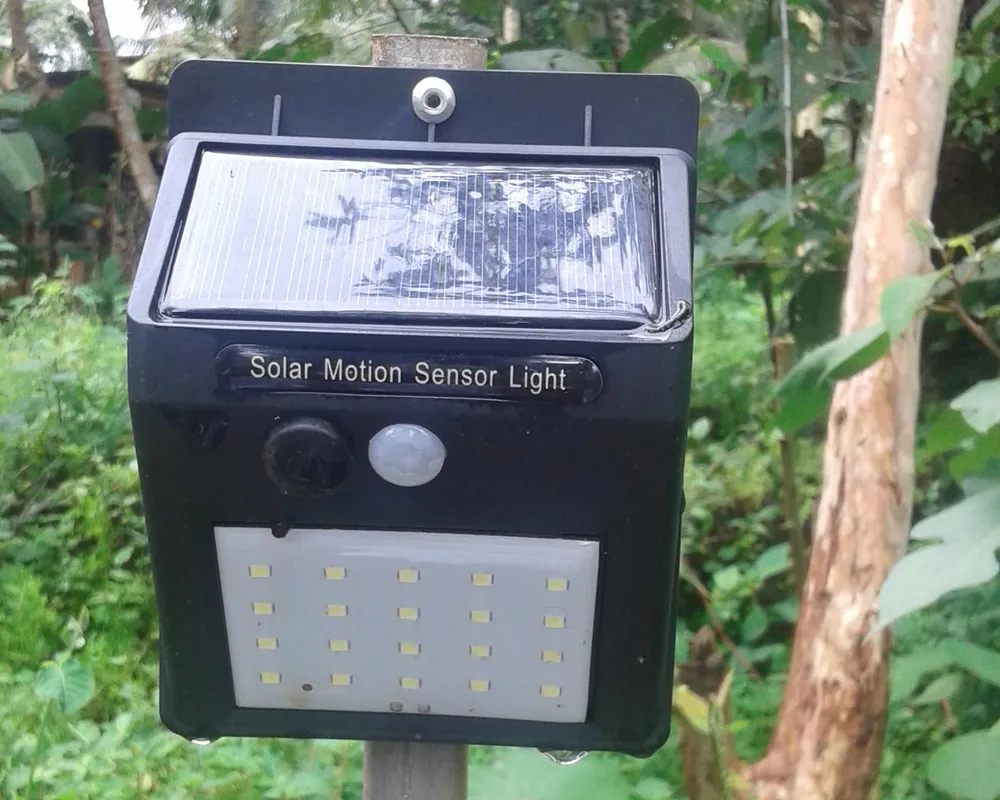
A solar motion light is the easiest security upgrade there is. It needs no wiring and no electrician, and it keeps working when the grid is down. A small solar panel charges a built-in battery during the day, and at night a passive infrared (PIR) sensor switches the LEDs on when it detects a warm moving body: a person, a car or the neighbor's cat. The listings all look alike, so this guide explains the numbers that matter, how to aim the light so it helps instead of glaring, and two inexpensive 2-packs.
Lumens: how bright is bright enough?
Lumens measure light output. Watts measure the power a bulb uses. The FTC's rule of thumb is that a standard 60-watt incandescent bulb gave about 800 lumens. For outdoor home lighting, DarkSky International's Home Outdoor Lighting Assessment suggests:
- 300 lumens or less for pathways and steps.
- 300–800 lumens for a garage or other work area.
- Keeping any single fixture under 1,000 lumens total.
Many solar security lights advertise 2,000 lumens or more. Treat those numbers as seller claims: they come from the seller, not from a standardized label like the Lighting Facts panel on a bulb box. More lumens also isn't automatically more security. A very bright light aimed outward creates glare and deep shadows, which can make it harder to see who is standing just past the beam. A moderate light aimed down at the door, driveway or side gate usually does more good.
Color temperature and glare
Most solar security lights, including both picks below, use 6500K "daylight" white LEDs. DarkSky recommends warmer light outdoors (2700K or lower), and accepts 3000K when the fixture is shielded, motion-controlled and aimed where it's needed. If you buy a cool-white solar light anyway, you can cut most of the downside by following DarkSky's other principles:
- Targeted: tilt the heads down at the ground you want to see, not out toward the street or a neighbor's windows.
- Controlled: use the motion-only mode so the light is off until someone's there. It also saves battery.
- Useful: light the entry points (doors, the side gate, the garage apron), not the whole yard.
Heads, sensors and modes
- Number of heads. Multi-head units (often 3) have adjustable panels that spread light to the sides and front. That's handy at a garage corner where you want to cover both the driveway and a walkway. Single-panel wall units suit a single doorway.
- Sensor range. Listings quote a motion detection distance and angle. A wider angle catches more of a driveway, and a longer range triggers earlier. Mount at the height the maker recommends (both picks below say about 6.5 to 8 ft); too high and the sensor misses people up close.
- Lighting modes. Typical choices are motion only (full brightness on motion, otherwise off), dim plus motion (a low glow all night that jumps to full on motion) and constant dim. Dim modes drain the battery faster and run all night, which runs against DarkSky's "controlled" principle. Motion-only is usually the best default.
- Remote. A remote lets you switch modes without a ladder. If the light is mounted high, it's worth having.
Solar panel placement and battery
A solar light is only as good as the sun its panel gets. Mount it where the panel sees direct sun for most of the day, clear of eaves, trees and the shadow of the house. On a north-facing wall or under a deep porch roof, an integrated panel may never fully charge. In that case, look for a model whose panel connects by cable so you can mount the panel in the sun and the light where you need it.
Expect shorter run times after cloudy days and in winter. Built-in lithium-ion batteries also slowly lose capacity with age. One of our picks' makers suggests switching the light off for 2–3 sunny days to recharge it fully after a stretch of cloudy weather. If you live with long cloudy spells, or need light every night of the year at a critical entry, a hardwired motion fixture is the more reliable choice.
Weather ratings (IP65 and up)
The "IP" code comes from the international standard IEC 60529. The first digit is dust protection and the second is water protection:
- IP65: dust-tight and protected against water jets from a nozzle. That's plenty for rain on a wall-mounted light.
- IP66: dust-tight and protected against powerful water jets.
- IP67: dust-tight and protected against temporary immersion (up to 1 m for 30 minutes).
Both picks below are listed as IP65. Don't aim a pressure washer at them.
Packs and price per light
Solar security lights are usually sold in 2-, 4- or 6-packs. Divide the price by the number of lights to compare, and buy only as many as you have sunny mounting spots for. Inexpensive solar lights are a short-lived category: reviews of budget solar lights, including the Tuffenough listing below, report some units dimming or failing within months, and the batteries are generally built in rather than user-replaceable. Keep the box and receipt, note the return window, and register the 1-year warranty both sellers list.
Curated solar motion lights (2)
Two products only, both 2-packs under $30. Prices were checked on the live Amazon listings on October 30, 2026 and change often.
- Tuffenough 2500LM 210-LED Solar Motion Light, 3 heads (2-pack), about $24.67 for the pair (list $32.99). This is the pick with a remote. It has 3 adjustable heads with 210 LEDs and a claimed 2500 lumens at 6500K, 270° of light spread, a 26 ft motion range and three modes you change with the included remote. It has an 1800 mAh battery, is rated IP65 and carries a 1-year warranty. The seller recommends mounting at 6.5–8 ft.
- Daphino 2500LM 3-Head Solar Motion Lights (2-pack), about $23.79 for the pair (Amazon showed $18.99 for Prime members). This is the longer-range budget pick. It has 3 heads with 156 LEDs and a claimed 2500 lumens at 6500K, plus a 40 ft / 130° PIR sensor. It has three modes: motion only at full brightness, an all-night 30% glow, or a 10% glow that jumps to 100% on motion. The seller claims up to 12 hours in dim mode after a 7–8 hour sun charge. It has a 3.7 V Li-ion battery, is rated IP65 and carries a 1-year warranty. No remote is included.
Amazon links above are affiliate links. As an Amazon Associate we earn from qualifying purchases. Lumen, range and run-time figures are the sellers' claims; we haven't measured them.
Where this fits in the house
Solar lights keep the driveway lit during an outage, the same night your garage door opener needs its backup battery. See our garage door opener with battery backup guide. For hardwired outdoor fixtures and the rest of your electronics, a whole-house surge protector is the other half of outage prep. All our picks are on the Products page.
Bottom line
Pick the mounting spot first. If it gets real sun, a $25 pair of 3-head solar motion lights is an easy, wire-free way to light entry points. Use motion-only mode, aim the heads down, mount at about 6.5–8 ft, and treat 2,500-lumen claims as more than you need (DarkSky suggests 300–800 lumens for a garage area). If the spot is shaded or the light has to work every night, choose a separate-panel model or a hardwired fixture instead.
Sources
- DarkSky International: Home Outdoor Lighting Assessment (lumen ranges, shielding, color temperature, motion sensors)
- DarkSky International & IES: Five Principles for Responsible Outdoor Lighting
- FTC Consumer Advice: Shopping for light bulbs (about 800 lumens is roughly a 60 W incandescent)
- ENERGY STAR: Learn about brightness
- IEC: IP ratings (IEC 60529)
- Amazon listings for ASINs B09F3DJNGF (Tuffenough AMS297) and B0D47FT8LN (Daphino JY2322B-3H-NR-2P): specs, prices and seller usage tips (checked October 30, 2026)
Information only; not professional advice. Lighting is one part of home security, not a guarantee. Use a sturdy ladder and a helper when mounting lights overhead.