
Whole-house surge protector guide: panel vs point-of-use
Affiliate disclosure: Product links below are Amazon affiliate links. As an Amazon Associate we earn from qualifying purchases, at no extra cost to you. We have not hands-on tested these units; specs are summarized from Eaton and Siemens documentation as of October 29, 2026. See our affiliate disclosure.
Last reviewed: October 29, 2026.
Most homes now run on electronics: control boards in the furnace, heat pump, water heater, refrigerator, washer and garage door opener, plus TVs and computers. A whole-house surge protector (a surge protective device, or SPD, at the electrical panel) and point-of-use protectors (plug-in strips and receptacles) do different jobs. This guide explains the difference, what the label ratings mean, what the electrical code now requires, and two panel SPDs worth asking your electrician about.
Safety first: a panel SPD connects inside or beside your service panel, where the main lugs stay energized even with the main breaker off. Have a licensed electrician install it and pull any required permit. This guide does not give installation steps.
Panel vs point-of-use in plain English
UL 1449, the safety standard for surge protective devices, sorts them by where they are installed:
- Type 1: permanently connected and rated for the line side or load side of the service disconnect (main breaker). These can go at the meter/service entrance.
- Type 2: permanently connected on the load side of the service disconnect, typically on a breaker in the main panel or a subpanel.
- Type 3: point-of-utilization devices, such as plug-in strips, cord-connected units and SPD receptacles, installed at least 10 m (about 30 ft) of wire away from the service panel.
A panel SPD (Type 1 or 2) is built to divert large surges that come in on the utility lines, such as nearby lightning or grid switching, before they reach every circuit. It does not stop surges made inside the house when motors and compressors cycle, and it does not protect cable, coax, phone or Ethernet lines unless you add protection for those too. Point-of-use protectors clamp what's left at the device itself. Leviton, NEMA's surge section and the National Institute of Standards and Technology all describe the same layered approach: a Type 1 or 2 device at the service plus Type 3 protection at sensitive electronics. Neither layer replaces the other.
Note: surge protection doesn't help with a direct lightning strike to the house, and it isn't a backup-power or voltage-sag fix. For those you'd need a lightning protection system and a UPS or generator.
What the electrical code says (NEC 230.67)
The 2020 National Electrical Code added section 230.67. All services supplying dwelling units must have an SPD. It must be part of the service equipment or located right next to it, and it must be Type 1 or Type 2. The rule also applies when service equipment is replaced. One exception lets the SPD sit at the next level of distribution equipment downstream instead. The 2023 NEC kept the rule and extended it to dormitory units, hotel and motel guest rooms and suites, and nursing-home patient sleeping areas. It also added a minimum nominal discharge current (In) of 10 kA.
States and cities adopt NEC editions on their own schedules, and some amend them. If you're upgrading a panel or meter base, ask your electrician which edition your jurisdiction enforces. Many panel replacements now need an SPD anyway, so it's cheaper to plan for one up front.
How to read the label (UL 1449 ratings)
- Type (1, 2 or 3): where it may be installed (see above).
- VPR (voltage protection rating): the let-through voltage measured in a standard 6 kV / 3 kA test. Lower is better. Results are published in standard steps, from 330 V upward (for example 600, 700 or 1,000 V).
- In (nominal discharge current): 10 kA or 20 kA. This is the surge level the device must survive repeatedly in testing. Type 1 and Type 2 devices are rated at 10 kA or 20 kA, and the 2023 NEC requires at least 10 kA.
- SCCR (short-circuit current rating): the fault current the SPD can safely withstand. It must match or exceed the available fault current at your panel, which your electrician can check.
- MCOV (maximum continuous operating voltage): the highest steady voltage the SPD tolerates. On a U.S. 120/240 V home this is typically 150 V line to neutral.
- "kA per mode," surge current or joules: peak-capacity marketing numbers. NEMA's surge section warns that energy (joule) ratings in particular can be misleading, so compare VPR, In and SCCR first.
UL 1449 checks that the device is safe and measures its VPR. It does not judge whether that VPR is low enough for any particular appliance. Keep the leads short (installation location matters), and check the status lights after storms. Most panel SPDs are sacrificial and show a fault light when they need replacing.
Curated panel SPD picks (2)
Two products only. Both are for standard U.S. 120/240 V single-phase homes. Confirm fit with your panel brand and your electrician before buying. Prices change, so check the live listing.
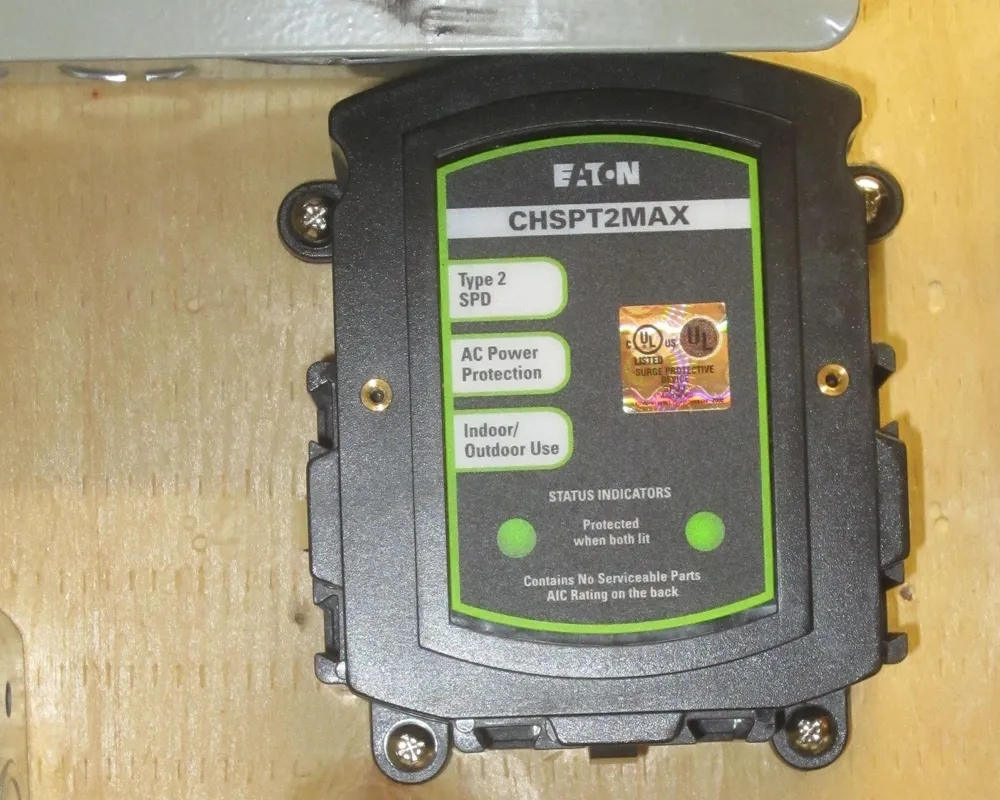
- Eaton CHSPT2ULTRA Ultimate Surge Protection is a premium Type 2 SPD (UL 1449 5th edition) in a NEMA 4 enclosure. It mounts outside the panel and connects to a dedicated two-pole breaker, so it works with any brand of loadcenter. Eaton lists the VPR as 600 V line-neutral and 1,000 V line-line. In is 20 kA when used with a 50 A two-pole breaker (10 kA with a 15 A breaker), SCCR is 22 kA, MCOV is 150 V, and surge current is 108 kA (54 kA per mode). It has LED status lights and a limited lifetime warranty with connected-equipment coverage, which Eaton lists as up to $75,000. Coax and phone-line protection are separate Eaton modules.
- Siemens QSPD2A035B BoltShield 35kA is a budget plug-in SPD for Siemens loadcenters. It goes in two adjacent breaker spaces, in any spot that accepts a Siemens 2-pole QP breaker. Siemens notes that some "half-bus" meter-combo panels aren't compatible. It's listed as a UL 1449 Type 1 SPD and is also suitable for Type 2 applications. Siemens lists In at 20 kA, SCCR at 22 kA, MCOV at 150 V, VPR at 700 V line-neutral and 1,200 V line-line, and surge capacity at 35 kA per phase. It has green/red indicator flags and a 3-year / $10,000 warranty per the Siemens datasheet. It only makes sense if your panel is a Siemens.
Amazon links above are affiliate links. As an Amazon Associate we earn from qualifying purchases. Equipment-coverage warranties have claim conditions, so read the maker's terms.
Point-of-use: what to look for
- A UL 1449 listing marked as a surge protective device, not just a "power strip" (UL 1363 relocatable power taps don't have to include surge protection).
- A low VPR, such as 330 V or 400 V on 120 V strips, and an indicator light that shows protection is still working.
- Coax, phone or Ethernet pass-through if the device also connects to those lines. Surges can come in on any conductor.
- Use them on TVs, computers, networking gear and smart-home hubs. Hard-wired appliances such as HVAC equipment, ranges and water heaters can't use plug-in strips, which is where the panel SPD matters most.
Where this fits in the house
HVAC control boards and inverter-driven heat pumps and mini-splits are expensive to replace after a surge. If you're comparing systems in our central AC vs DIY mini-split guide, budget for a panel SPD along with the equipment, especially if you're also upgrading the panel or service. Keep the equipment's filters and maintenance up to date too. Our furnace/AC filter MERV guide covers sizing.
Bottom line
Use both layers. Have a licensed electrician put a Type 1 or Type 2 SPD at the panel, which the NEC now requires for new and replaced dwelling services, then add UL 1449 Type 3 protectors at sensitive electronics. Compare VPR (lower is better), In (at least 10 kA, ideally 20 kA) and SCCR (must meet your panel's available fault current) before looking at peak-kA marketing numbers. Choose a universal external unit like the Eaton for any panel, or the Siemens plug-in if you have a compatible Siemens loadcenter.
Sources
- Eaton CHSPT2ULTRA product page and specifications (checked October 29, 2026)
- Eaton home surge protection warranty information (connected-equipment coverage), eaton.com (checked October 29, 2026)
- Siemens residential catalog and QSPD2A035B installation instructions; Siemens BoltShield SPD datasheet (checked October 29, 2026)
- NFPA 70, National Electrical Code 2020 and 2023, section 230.67 (Surge Protection), as summarized by Leviton Captain Code (NEC 2023 230.67)
- UL 1449, Standard for Surge Protective Devices (5th edition): device types, VPR, In and SCCR definitions
- NEMA Surge Protection Institute FAQs
- NIST, Surges Happen! How to Protect the Appliances in Your Home (NIST Special Publication 960-6)
Information only; not electrical advice. Panel and service work is dangerous and often requires a permit. Hire a licensed electrician and follow the manufacturer's instructions and your local code.