
Whole-house humidifier guide: bypass vs fan-powered vs steam
Affiliate disclosure: HVACDirect.com is an affiliate partner. Product links below use our affiliate tracking and may earn a commission at no extra cost to you. Use code TBZOQ3JUBY0G at checkout for an affiliate program product discount (about 3%; confirm on hvacdirect.com). We have not hands-on installed these products; specs and prices are summarized from HVACDirect listings and AprilAire manuals as of November 7, 2026. See our affiliate disclosure.
Last reviewed: November 7, 2026.
Forced-air heating dries out a house. Cold outdoor air holds little moisture, and once that air is warmed inside, relative humidity can drop sharply—AHRI notes it can fall as low as about 15% in winter, which feels desert-dry. The result is static shocks, shrinking wood floors and furniture, and that parched-sinus feeling many people notice when the furnace runs. A whole-house humidifier adds moisture into the duct system so every room on the forced-air system can share it, instead of parking a portable tank in one bedroom.
This guide covers how duct-mounted humidifiers work, the three common types (bypass, fan-powered and steam), how to think about gallons-per-day sizing, the winter humidity setpoints that keep windows from dripping, and the annual water-panel or HydroCore service that keeps an evaporative unit working. It is written for typical forced-air homes nationwide. It is not medical advice, and it does not repeat manufacturer marketing about viruses or infection.
1. How a whole-house humidifier works with forced-air HVAC
AHRI describes the usual evaporative setup: a humidistat (a control that measures relative humidity and turns the humidifier on and off) calls for moisture while the furnace or air-handler blower is running. Water flows into a distribution pan, then over an evaporative pad or cartridge. Warm, dry air passing through that wet media picks up water vapor, and the HVAC blower carries the humidified air through the supply ducts.
AprilAire's owner manual for the fan-powered Model 720 series walks through the same loop with a few extra steps. When humidity is low, the control opens a solenoid valve. Water reaches the one-piece HydroCore cartridge. The humidifier's own fan pulls air from the HVAC system through the HydroCore so evaporation can happen, and the furnace or air-handler fan then spreads that air through the house. When the setpoint is reached, the valve closes. The 720 series also recirculates water across the panel to raise output and cut waste; at the end of a cycle a surge of water may go down the drain to flush leftover minerals so the unit is not left sitting with standing water.
Two practical notes from that same listing and manual:
- These units are designed for compatible forced-air systems. Actual output depends on the house, how the HVAC system runs, and how the humidifier is installed.
- An HVACDirect FAQ on the 720M page says the unit will work with room-temperature air, but it performs best with heated air because warmer air evaporates more water. That matters on heat pumps and on short furnace cycles—see our heat pump sizing guide and furnace AFUE guide.
2. Bypass vs fan-powered vs steam
AHRI groups whole-house humidifiers into units that use the furnace or air-handler fan to move air across the wet media, and units that have their own built-in fan. Steam is a third family: it boils water and adds vapor without waiting on a wet pad and a blast of hot supply air.
- Bypass evaporative. A bypass duct connects the supply and return (or the unit mounts so furnace airflow is forced through the pad). When the HVAC blower runs, some air crosses the water panel, picks up moisture, and returns to the duct system. These are the simpler, quieter evaporative units. Output depends heavily on how long and how warm the blower runs. AprilAire's FAQ lists the Model 500 at about 11 gallons per day (typically homes up to about 1,500 sq. ft.) and the Models 600 and 700 at about 16–17 gallons per day (typically homes up to about 3,000 sq. ft.). The 500 and 600 are the common bypass-style models in that lineup; the 700 is fan-powered.
- Fan-powered evaporative. A built-in fan pulls air through the pad even when furnace airflow alone would be a weak drive. AprilAire calls the Model 720 its highest-capacity evaporative humidifier, at up to 21 gallons per day for homes up to 6,250 sq. ft. The 720M on HVACDirect is this type: low speed up to 19 GPD and high speed up to 21 GPD in the listing's feature bullets, with a reversible fan module for different furnace orientations. The owner manual says switching the fan from the default HIGH to LOW cuts capacity by about 10% and can quiet the unit if it sits near living space.
- Steam. AprilAire's FAQ describes the Model 800 steam humidifier as heating water to boiling in a replaceable canister and draining that canister on a weekly cycle. Because the moisture is steam, the unit does not depend on hot furnace air passing through a wet pad. That is why steam is the usual recommendation when the heating system is a heat pump, a short-cycle furnace, or anything else that does not send a long stream of hot air across an evaporative panel. Steam costs more to buy and to maintain (the canister is a consumable), and it needs proper electrical capacity and a drain.
A rough way to choose: a modest, reasonably tight house with a gas furnace that runs often in winter can do well with a bypass unit. A larger house, a leakier house, or a system with short blower cycles is a better match for fan-powered evaporative capacity. Steam is the step up when evaporative output will not keep up, especially on a heat pump.
3. Rough sizing: GPD, tightness and climate
Humidifiers are rated in gallons per day (GPD) of moisture they can add, and manufacturers translate that into a maximum home size. Those square-footage numbers assume a fairly typical ceiling height and a house that is not a sieve. A leaky older house in a cold, dry climate needs more added moisture than a tight new house of the same floor area, because infiltration keeps bringing in dry outdoor air. High ceilings increase the volume you are trying to humidify.
AprilAire's published evaporative ratings (from its humidifier FAQ, checked November 7, 2026) are a useful ladder:
- About 11 GPD — Model 500, typically up to about 1,500 sq. ft.
- About 16–17 GPD — Models 600 and 700, typically up to about 3,000 sq. ft.
- Up to 21 GPD — Model 720, AprilAire's figure for tightly constructed homes up to 6,250 sq. ft.
HVACDirect lists the 720M the same way: up to 21 GPD and homes up to 6,250 sq. ft. The same listing's specification table also shows a capacity of 18 gallons per day and an evaporation rate of 0.75 gallons per hour, while AprilAire's FAQ gives the Model 720 evaporation rate as 0.88 gallons per hour on high speed and 0.79 on low. Treat the "up to 21 GPD" figure as a maximum under favorable conditions, not a guarantee, and confirm the current spec sheet when you order.
AHRI also points out that output depends on furnace run time, the humidistat setpoint, and how well the house holds humidity—the same caveats AprilAire lists. If the furnace hardly runs (mild climate, or a heat pump that meets the load without long hot-air cycles), an evaporative unit may never reach its nameplate GPD. Plumbing an evaporative unit to hot water can raise output; AprilAire recommends hot water for Models 500, 600, 700 and 720, and notes those units do not draw enough water to fire a typical tankless heater.
4. Winter humidity setpoints and window condensation
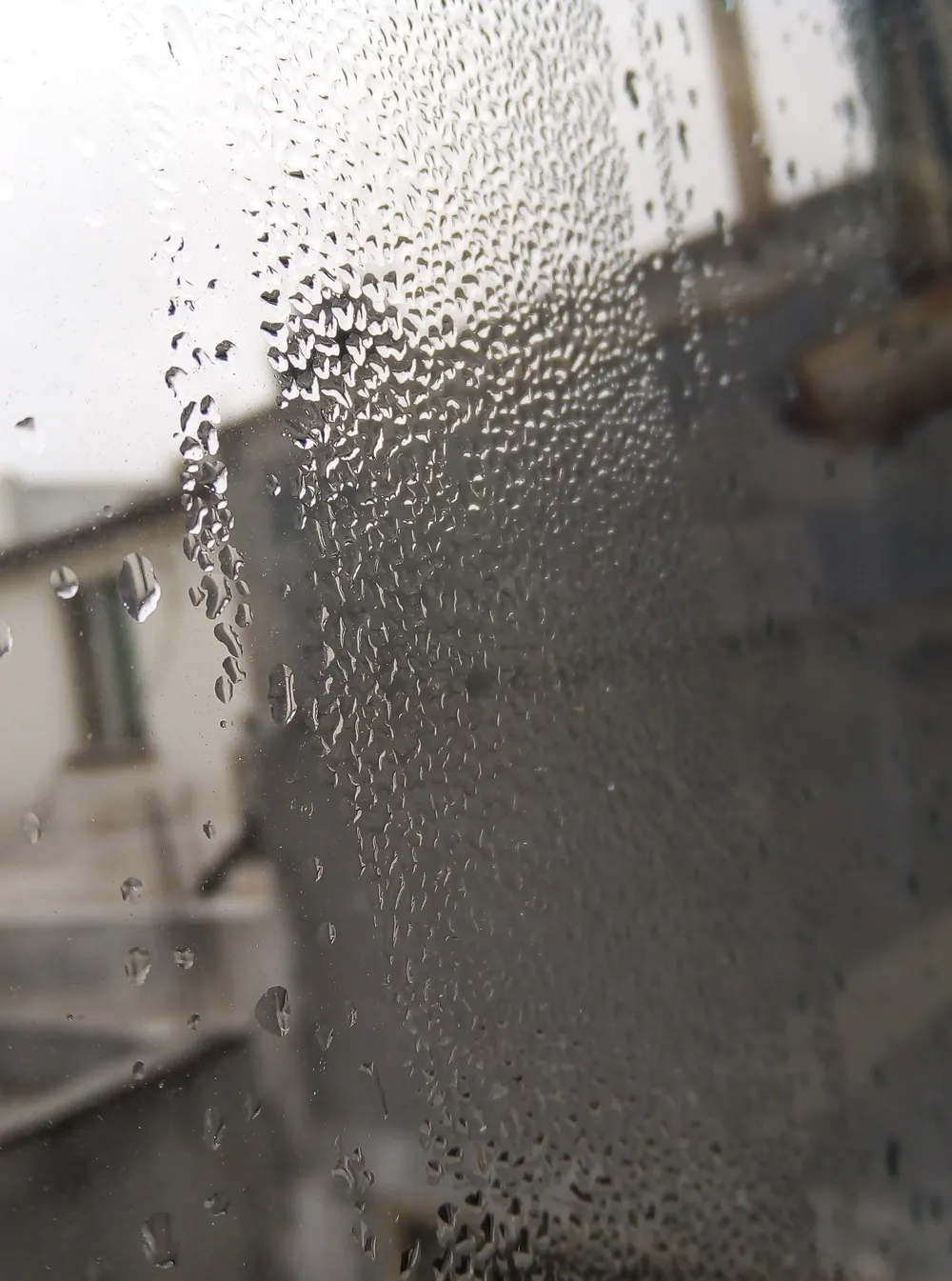
More humidity is not always better. When warm indoor air hits a cold window, the glass can drop below the dew point and water (or frost) appears on the inside. AHRI and AprilAire both treat fogging or frost on interior window surfaces as a sign that indoor humidity is too high, and both warn that the same condensation can show up in other cold spots in the house.
The Pacific Northwest National Laboratory's Building America Solution Center puts comfortable indoor humidity in a band of about 35% to 50% relative humidity, and notes that brief window condensation that dries quickly is less of a worry than condensation that lingers and soaks sills or frames. In very cold weather, many houses cannot hold the middle of that band without wetting the windows. AprilAire's 720 owner manual says the equipment can help maintain up to about 45% RH, with a recommended range of 35% to 45%, and that the lower end may be all a house can manage when it is bitterly cold, depending on window age, air leakage and insulation.
For a manual humidistat, AHRI and AprilAire publish the same outdoor-temperature table. Anticipate a cold snap and turn the dial down before the glass gets wet:
- Outdoor +40°F → about 45% indoor RH
- +30°F → about 40%
- +20°F → about 35%
- +10°F → about 30%
- 0°F → about 25%
- −10°F → about 20%
- −20°F → about 15%
AHRI's example matches the table: at 20°F outdoors, set about 35% RH; if the night will fall to 0°F, reduce the setting to about 25% several hours ahead. If windows are already wet, AprilAire's troubleshooting list says to lower the setpoint by about 5% (one increment) and, if the humidifier is not even running, look at indoor moisture sources such as showers and cooking, then ventilate if the glass stays wet for hours or days.
5. Annual HydroCore / water-panel maintenance and hard-water scale
Evaporative humidifiers leave minerals behind when water turns to vapor. AprilAire's 720 owner manual is blunt about the service that prevents that scale from choking the unit:
- Replace the one-piece HydroCore cartridge at least once a year. For the 720 series the replacement is HydroCore Model L (part HYDROL). Older AprilAire bypass and fan-powered models use a flat water panel (commonly the #35 on 600- and 700-series units), which AprilAire's FAQ says to replace once per heating season.
- On hard water, replace the orifice and clean the valve every year. On soft or softened water, AprilAire says to do that every three years or as needed. The manual describes shutting the control off, removing the HydroCore, brushing mineral deposits from the base, soaking the valve cup in white vinegar for up to 30 minutes, flushing, and installing a new orifice and seal cap (hard-water kit HYDRLH includes those parts for the 720).
- Most leftover solids flush down the drain at the end of a cycle. Residue from hard water tends to be hard and scaly; residue from softened water tends to be softer and fluffier. Either way, the HydroCore still needs yearly replacement. AprilAire recommends a scale-reducing inline filter on hard water to slow the buildup.
- For summer shutdown, turn the humidistat to OFF so the unit is not calling for moisture when you no longer want it.
HVACDirect did not list a HydroCore L cartridge on its site when we checked on November 7, 2026, so the annual part is something to order from an AprilAire dealer or the manufacturer if your installer does not stock it. Do not substitute an older #35 water panel in a 720-series unit—the 720 uses the HydroCore cartridge, not that pad.
6. When a portable humidifier is not a substitute
AHRI draws a clear line: portable room humidifiers need frequent filling and regular hands-on attention, while a whole-house unit works through the central system. A portable can take the edge off one room, but it cannot feed the duct system. Run one hard in a bedroom and that room can fog its own windows while the hallway and the far bedrooms stay dry. Whole-house equipment, sized and set correctly, humidifies the air the furnace is already moving.
Portables also concentrate standing water in the living space. They have their place as a temporary comfort tool; they are not a substitute for a duct-mounted unit if the goal is balanced humidity throughout a forced-air house.
Curated humidifier picks (2)
Two HVACDirect products only: a fan-powered AprilAire whole-house humidifier and the matching manual humidistat sold as a replacement. Prices were checked on the live HVACDirect listings on November 7, 2026 and change often.
- AprilAire Model 720M Fan-Powered Whole-House Humidifier with Manual Control, $479.99 on hvacdirect.com. The listing describes a fan-powered evaporative unit for homes up to 6,250 sq. ft., with up to 19 GPD on low speed and 21 GPD on high speed, HydroCore recirculation that AprilAire says cuts wastewater by up to 60% compared with the Model 700, and a reversible fan assembly for vertical or horizontal furnaces. It includes the Model 4655 manual humidistat, a HydroCore cartridge, a 24-VAC transformer, a saddle valve and a template. Electrical requirement on the listing is 120V, 60 Hz; cabinet size is 16.5″ W × 18″ H × 10.5″ D. AprilAire's owner manual states a five-year limited warranty; HVACDirect's listing shows both a "10-Year Parts Limited Warranty" feature line and a "5-Year Warranty" in the specification table, so confirm warranty terms before you buy. Installation belongs with a licensed HVAC contractor. Use code TBZOQ3JUBY0G at checkout.
- AprilAire Manual Analog Humidistat (Model 4655), $69.95 on hvacdirect.com (shown as marked down from $100.00). This is the under-$100 pick. HVACDirect describes a wall- or duct-mount, low-voltage on/off humidistat: a nylon ribbon expands as relative humidity rises and opens the control switch, then contracts as the air dries and closes it again so the humidifier can run. The 720M already ships with a 4655, so you do not need a second one with a new unit; this listing is the genuine matching control if you are replacing a failed humidistat or completing an older AprilAire install. We looked for a HydroCore L cartridge on HVACDirect tonight and did not find one, and the older AprilAire #35 water panel sold there does not fit the 720 series. Use code TBZOQ3JUBY0G at checkout.
Prices and specs come from HVACDirect listings and AprilAire documents and can change. Confirm the current price, capacity, control type and warranty before you buy.
Where this fits in the house
A whole-house humidifier is an add-on to a forced-air furnace or air handler, not a replacement for either one. If you are choosing or sizing the heating system itself, start with the furnace AFUE guide, the heat pump sizing guide and central AC vs DIY mini-split. The same blower that moves humidified air also needs the right filter—see the furnace/AC filter sizes and MERV guide. HVAC picks are listed on the Products page.
Bottom line
Pick the humidifier type that matches how your heating system actually runs: bypass when a gas furnace blows plenty of hot air, fan-powered when you need more evaporative capacity, and steam when there is not enough hot supply air to evaporate water from a pad. Size from published GPD and a realistic view of house tightness and climate, then set the humidistat to the outdoor-temperature table so the windows stay dry. Replace the HydroCore or water panel every heating season, service the orifice on hard water, and treat a portable unit as a one-room stopgap, not a whole-house solution.
Sources
- AHRI: How Humidifiers Work (winter indoor dryness; evaporative operation; built-in fan vs furnace fan; portable vs whole-house; outdoor-temperature RH setpoints; window condensation)
- AprilAire Series 720 Owner's Manual (PDF hosted by HVACDirect) (720 operating sequence; HydroCore maintenance; hard-water orifice service; manual humidistat Table 2 setpoints; recommended 35–45% RH; five-year warranty)
- AprilAire: FAQs on whole-house humidifiers (GPD and home-size ratings for Models 500, 600, 700 and 720; Model 800 steam canister; hot-water plumbing notes; water-panel replacement intervals)
- PNNL Building America Solution Center: Managing Indoor Humidity and Ventilation in Cold Weather (about 35–50% indoor RH; window condensation as a high-humidity sign)
- HVACDirect listings for the AprilAire 720M and 4655 humidistat: specs and prices (checked November 7, 2026)
Information only; not HVAC, engineering or health advice. Have a licensed HVAC contractor size and install a whole-house humidifier, including water, drain, electrical and control wiring, to local code and the manufacturer's instructions. Indoor humidity that is too high can damage windows, woodwork and building materials; use the outdoor-temperature table and watch for condensation.