
Well water UV systems for Texas homes: test first, pretreat, then disinfect

Affiliate disclosure: iSpring and SoftPro are affiliate partners. Product links below use our affiliate tracking and may earn a commission at no extra cost to you. We have not hands-on tested these products; specs and prices are from iSpring's own product pages as of November 13, 2026. See our affiliate disclosure.
Last reviewed: November 13, 2026.
- Texas A&M AgriLife's Texas Well Owner Network says to test a private well at least once a year for coliform bacteria and nitrate.
- UV kills or inactivates bacteria, viruses and protozoa. It does not remove nitrate, arsenic, hardness, iron or other chemicals.
- UV only works on clear water. Put a sediment filter (and a softener or iron filter if your test calls for it) ahead of the UV unit.
If your home is on a private well, nobody tests that water for you. The Texas Water Resources Institute reports that out of every 100 well samples the Texas Well Owner Network screens, on average 15 to 20 test positive for coliform bacteria and 3 to 5 for E. coli. A whole-house UV system is one of the simplest chemical-free ways to disinfect well water, but only after you know what's in the water and the water is clear enough for UV to work.
1. Test before you buy anything
- Baseline: TWON's well owner guide suggests a one-time panel that includes arsenic, hardness, iron, manganese, nitrate, pH, sodium, sulfate, total coliform, TDS and more.
- Every year: total coliform bacteria and nitrate (and TDS to watch for trends).
- Retest any time the water changes color, taste or odor, after pump or well work, after flooding, or if someone gets a stomach illness.
- Use a lab accredited by TCEQ. Your county Extension office, groundwater conservation district or local health department can point you to one.
If you'd like a mail-in lab panel, SoftPro sells a well water test kit (from $159; affiliate link).
2. If bacteria show up: fix the source first
Texas A&M AgriLife's coliform guidance lists the order: find and fix how bacteria got in (a cracked well cap, poor seal, flooding or a nearby septic system), shock-chlorinate the well (ideally done by a licensed well driller or pump installer), and retest. For ongoing protection, it lists UV, distillation, ozone or continuous chlorination as household disinfection options.
3. What UV does and doesn't do
- Does: disinfects water as it flows past a UV lamp. No chemicals, no taste change and no byproducts.
- Doesn't: remove nitrate, arsenic, salts, hardness, iron, sulfur smell or sediment. Those need their own treatment.
- Only treats water while it flows through the chamber. It doesn't leave a residual, so bacteria already in the pipes or water heater aren't fixed by UV alone.
4. Pretreatment: why clear water matters
Particles can shade microbes from the UV light, and minerals coat the quartz sleeve around the lamp. TWON's water-treatment guide notes UV needs clear water to be effective. In practice that means:
- A sediment filter first. See our whole-house sediment filter guide.
- A softener if your water is hard, and iron or manganese treatment if your test shows them. Check the UV unit's manual for its water-quality limits.
- UV goes last in line, right before the water heads into the house.
5. Sizing and installation basics
- Flow rate: size the UV unit to your peak household flow (several showers, the washer and a hose running at once), not your average use. Water moving faster than the rating gets less UV exposure.
- Connection size: match the unit's inlet and outlet to your main line or plan the adapters.
- Power: lamp units need a nearby outlet, ideally on a circuit that stays on. A flow sensor saves power and lamp life.
- Bypass valves let you service the system without shutting off water to the house.
- After installing, disinfect the household plumbing downstream once (the manual explains how), then retest the water.
6. Upkeep
- Replace the lamp on schedule, usually yearly for mercury lamps. A lamp can still glow after it has lost disinfecting power.
- Clean the quartz sleeve every 6 to 12 months (iSpring's guidance for the UVF55FS), or more often with hard or iron-rich water.
- Keep testing the water at least yearly, even with UV in place.
Three iSpring UV picks
Prices were checked on ispringfilter.com on November 13, 2026 and change often. Coupon code REFISPRING may apply at checkout.
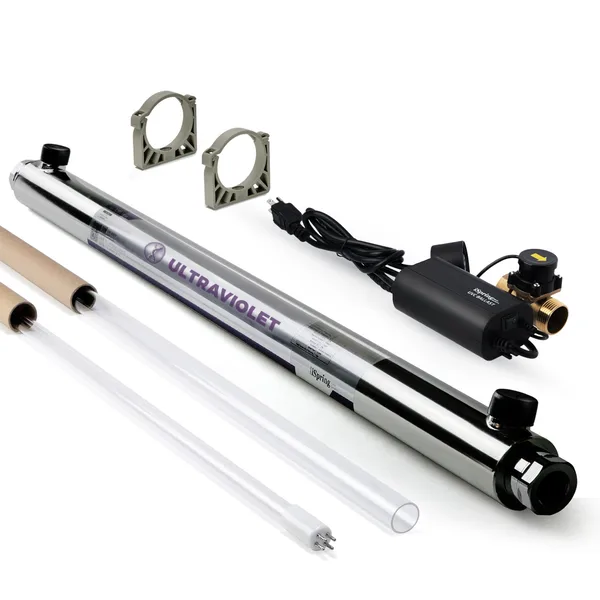
iSpring UVF55FS 55W Whole-House UV with Flow Sensor
$338.99
12 GPM, 1-inch MNPT, 37.5-inch stainless chamber. The flow-sensor ballast has Auto, Move and Stop modes; in Auto it kicks on at about 0.66 GPM. Lamp rated up to 9,000 hours (per iSpring).
View on iSpringCode REFISPRING
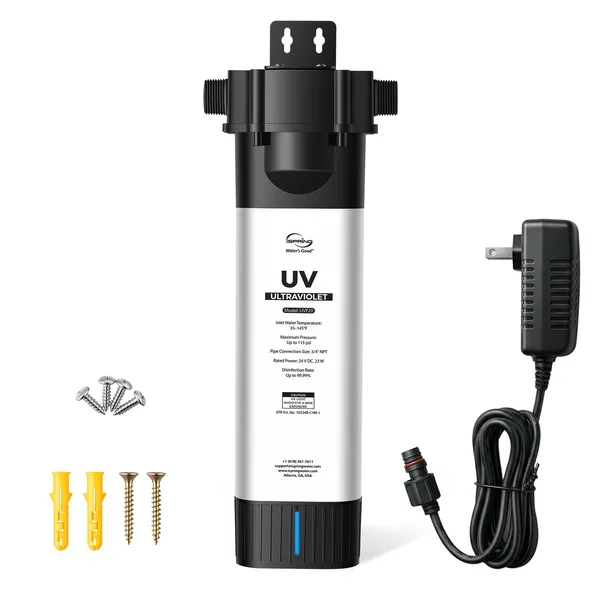
iSpring UVF20 Whole-House LED UV (Mercury-Free)
$309.99
Up to 12 GPM, 3/4-inch MNPT. The LED module turns on only when water flows, with no warm-up and no bulb swaps. Rated for 8,000 hours (per iSpring).
View on iSpringCode REFISPRING
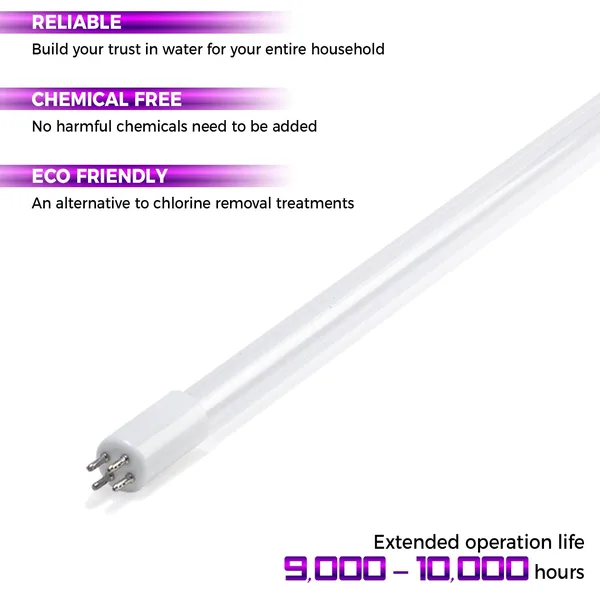
iSpring UVB55FS 55W Replacement UV Lamp
$79.99
The yearly lamp for the UVF55FS. 55 watts, 4-pin, about 35 inches long, rated up to 9,000 hours (per iSpring).
View on iSpringCode REFISPRING
iSpring and SoftPro links above are affiliate links. Specs are iSpring's own claims, and we have not tested them. Check iSpring's manual for water-quality limits before you install.
DIY or call a pro?
- Good DIY job: adding a UV unit and sediment filter on accessible pipe near the pressure tank, with a bypass and an outlet nearby.
- Call a pro: for shock-chlorinating the well, repairing a well cap or seal, any work on the pump or pressure switch, or if tests show nitrate, arsenic or other chemicals that need a different treatment.
Bottom line
Test first. If bacteria are the problem, fix the source, shock the well and then add UV as the final step after sediment and hardness treatment. Change the lamp on schedule, clean the sleeve, and keep testing every year.
Related: whole-house sediment filters, reading a water quality report, and water softener sizing.
Sources
- Texas Water Resources Institute: How often should I get my well water tested? (annual bacteria testing; 15 to 20% coliform and 3 to 5% E. coli positive rates)
- TWON: Well Owner's Guide to Water Supply (baseline and annual testing schedule)
- Texas A&M AgriLife: What to do about coliform bacteria in well water (fix the source, shock chlorination, UV and other disinfection)
- TWON: Water Quality Problems in the Home (testing labs and treatment options)
- TCEQ accredited laboratories
- iSpring product pages for UVF55FS, UVF20 and UVB55FS: specs and prices (checked November 13, 2026)
Information only; not health or water-treatment advice. Follow the manufacturer's instructions, and talk to your county Extension office or a licensed water well professional about your test results.