
Water softener grain capacity explained: 32K vs 48K vs 64K
Affiliate disclosure: SoftPro Water Systems is an affiliate partner. Product links below use our SoftPro referral tracking and may earn a commission at no extra cost to you. We have not hands-on tested these products; specs and prices are from SoftPro's own product pages as of November 16, 2026. See our affiliate disclosure.
Last reviewed: November 16, 2026.
- A softener's grain rating is how much hardness its resin can remove between regenerations, measured in grains. Hardness is counted in grains per gallon (gpg).
- Sizing formula used by several makers: (people × 75 gallons) × compensated hardness × days between regenerations, then round up to the next size. Compensated hardness adds 4 gpg for every 1 ppm of iron and manganese.
- Rated capacity assumes a high salt dose. At efficient settings a unit delivers roughly 67% of its rating (AFW), so a 32K softener behaves like about 21,400 grains.
- Bigger is not automatically better: a unit that regenerates too rarely can foul and channel, and costs more up front.
Shopping for a softener quickly turns into a choice between 32,000, 48,000 and 64,000 grains. The number is simple, but it only means something once you know your water's hardness and how much your household uses. This guide walks through the math in plain steps. For a hands-on worksheet, see our softener sizing calculator guide; for maintenance after install, see the maintenance checklist.
1. What a "grain" is
The U.S. Geological Survey defines hardness as mostly dissolved calcium and magnesium, and classes water as soft (0 to 60 mg/L as calcium carbonate), moderately hard (61 to 120), hard (121 to 180) and very hard (over 180). Softener makers use grains per gallon instead. To convert, divide mg/L (ppm) by 17.1. So 171 mg/L is 10 gpg, and 342 mg/L is 20 gpg. You can find your number on your utility's annual water quality report, or test it yourself; private well owners must test.
A "32K" softener holds enough resin to take up about 32,000 grains of hardness before it needs to regenerate with a salt brine. Think of it as a tank that fills with hardness, then gets flushed.
2. The sizing formula
- Hardness in gpg. Divide ppm by 17.1.
- Add iron and manganese. Add the two together in ppm, multiply by 4, and add that to your hardness. AFW and Nelsen both use this compensation; most softeners are only rated for roughly 2 ppm of dissolved (clear-water) iron, and more needs separate treatment.
- Daily use. Nelsen and Water World both use 75 gallons per person per day. A water bill or meter gives a better figure.
- Days between regenerations. Nelsen suggests 3 to 5 days; AFW says water without iron is typically sized for 7 to 14 days, and with iron 3 to 7.
- Multiply them together and round up to the next available size.
Worked example (Nelsen): four people, 20 gpg and 1 ppm iron. 300 gallons a day × 24 gpg compensated = 7,200 grains a day. At 3 days between regenerations that is 21,600 grains, which points to a 32,000-grain class unit.
3. Why usable capacity is less than the label
AFW notes that softeners are rated at maximum capacity using a high salt dosage. At more efficient settings most systems operate at roughly 67% of stated capacity while using about 37% of the salt. Water World gives a similar example: a 1 cu ft unit rated 32,000 grains at about 15 lb of salt may deliver around 24,000 grains at 6 lb, nearly doubling grains removed per pound of salt. A reserve is also held back so you do not run out of soft water mid-day.
The table below applies AFW's 67% rule of thumb to the three common sizes. It ignores the reserve, so real intervals run a bit shorter. These are our own arithmetic from the sources above, not a manufacturer promise.
| Household and water | Grains used per day | 32K: days between regens | 48K: days | 64K: days |
|---|---|---|---|---|
| 2 people, 10 gpg | 1,500 | 14.3 | 21.4 | 28.6 |
| 4 people, 10 gpg | 3,000 | 7.1 | 10.7 | 14.3 |
| 4 people, 20 gpg | 6,000 | 3.6 | 5.4 | 7.1 |
| 5 people, 20 gpg | 7,500 | 2.9 | 4.3 | 5.7 |
Read the table as a range: a 2-person home with 10 gpg water would stretch a 32K unit for weeks, which is why smaller households often do fine with the smallest size. A 5-person home on 20 gpg water would regenerate every 3 days or so on a 32K unit, so stepping up to 48K or 64K makes sense.
4. When bigger is worse
Nelsen puts the professional sweet spot at 2 to 4 days between regenerations and warns that oversized units regenerate too rarely, where resin can foul sitting idle in iron-bearing water, cost more up front, and can channel. Undersized units regenerate nearly daily, using salt and wearing the valve. Water World adds that high TDS, iron or manganese can cut available capacity enough that a unit regenerates daily.
Flow rate matters too. AFW says low hardness combined with a high flow rate may need a larger unit, so check the model's service flow rate against your peak demand, not just the grain number.
5. City water vs well water
City water is usually steady and has little iron, so the formula is simple. Wells vary: test hardness, iron, manganese and pH first, because iron changes the size (the 4× factor) and may call for a separate iron filter. See our filter vs softener vs RO guide if you are unsure which device fits.
Two SoftPro picks
Prices checked on softprowatersystems.com on November 16, 2026; SoftPro runs frequent sales and the listed "from" price is for the smallest size and package. SoftPro lists its ECO city softener in 32K, 48K and 64K grain capacities, and its own grain capacity calculator on the product page.
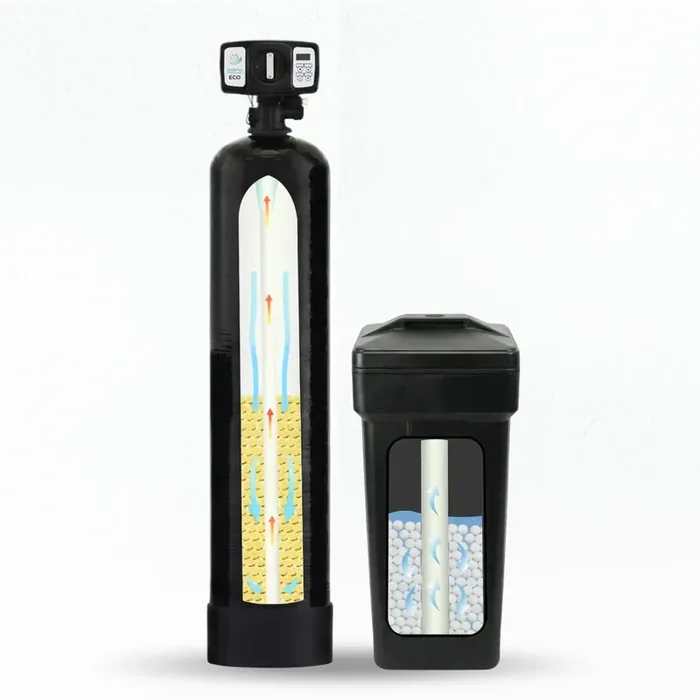
SoftPro ECO City Water Softener
From $967
Salt-based softener for municipal water in 32K, 48K and 64K sizes, with softener-only or filter packages. Handles low clear-water iron (SoftPro says up to 3 ppm). The simplest way to compare the three sizes in this guide.
View on SoftPro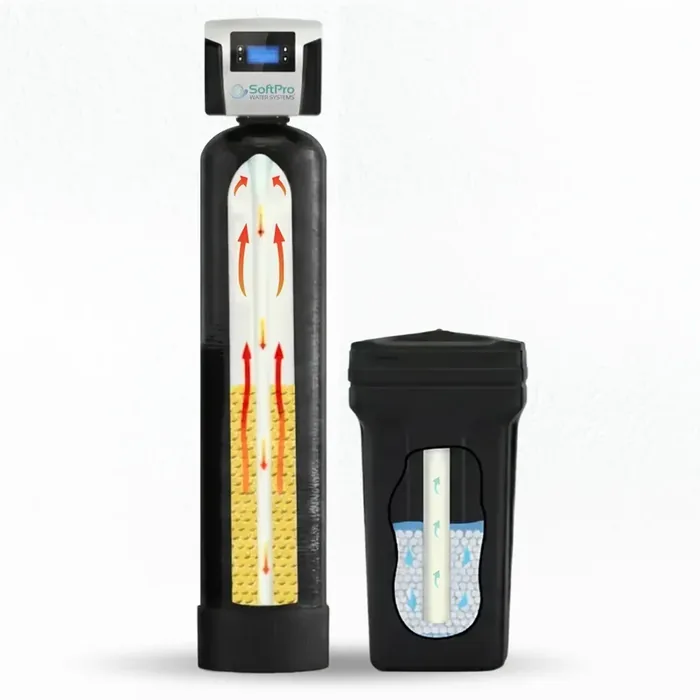
SoftPro Elite Smart HE (city)
From $1,367
SoftPro's higher-end city softener for larger or higher-demand homes. Check the size options on the product page against the daily grains you calculated.
View on SoftProSoftPro links above are affiliate links. Prices and specs are SoftPro's own as of November 16, 2026; we have not tested these units. SoftPro also sells a $89 salt level sensor, covered in our salt types guide.
Bottom line
Get your hardness number, multiply by realistic daily use, aim for roughly 3 to 7 days between regenerations depending on iron, and round up modestly. Most small households land on 32K, mid-size homes on 48K, and big or very hard-water homes on 64K. When you are right on a boundary, check the service flow rate before simply buying the bigger tank.
Sources
- USGS Water Science School: Hardness of water (what hardness is, mg/L classification)
- AFW: Water softener sizing guide (17.1 conversion, iron compensation, 67% efficient capacity)
- Nelsen Corporation: Water softener sizing calculator (75 gallons per person, worked example, oversizing)
- Nelsen Corporation: Softener sizing (compensated hardness, 3 to 5 days between regenerations)
- Water World: Sizing softeners (salt dose and capacity, oversizing and channeling)
- SoftPro ECO and Elite product pages on softprowatersystems.com: sizes and prices (checked November 16, 2026)