
Heat pump sizing guide: tons, Manual J, balance point and backup heat
Affiliate disclosure: HVACDirect.com is an affiliate partner. Product links below use our affiliate tracking and may earn a commission at no extra cost to you. Use code TBZOQ3JUBY0G at checkout for an affiliate program product discount (about 3%; confirm on hvacdirect.com). We have not hands-on installed these products; specs and prices are summarized from HVACDirect listings as of November 2, 2026. See our affiliate disclosure.
Last reviewed: November 2, 2026.
The most common heat pump mistake isn't the brand. It's the size. A heat pump that's too big cools the house in short bursts and leaves it clammy; one that's too small leans on expensive electric backup heat every cold morning. Getting it right takes a load calculation, a look at how the unit performs when it's cold outside, and a plan for backup heat. This guide explains each step so you can ask a contractor the right questions, or check a quote before you buy equipment yourself.
1. What "tons" actually mean
In HVAC, 1 ton = 12,000 BTU per hour of cooling. A "2-ton" heat pump is nominally 24,000 BTU/h, a 3-ton 36,000 BTU/h and so on. Nominal size is a label, not the real output: the 2-ton ACiQ system below, for example, is listed at 23,000 BTU/h for both cooling and heating at the 47°F rating point. And a heat pump's heating output falls as outdoor temperature drops, so the label tells you very little about how it handles your coldest nights.
2. Start with a load calculation, not square feet
A U.S. Department of Energy equipment-selection fact sheet tells builders to avoid simple rules of thumb such as BTUs per square foot and to calculate the heating and cooling loads for the actual house instead. The standard method is ACCA Manual J. It accounts for insulation, windows and their direction, air leakage, duct losses and your local design temperatures. The International Residential Code (section M1401.3) requires heating and cooling equipment to be sized with ACCA Manual S based on loads from Manual J (or other approved methods), so many jurisdictions expect a load calculation with the permit.
Two houses with the same square footage can need very different equipment. A tight, well-insulated home with good windows may need a ton less than an older, leaky house of the same size. That's why the square-foot coverage ranges on product listings are only a starting point.
Northeast Energy Efficiency Partnerships (NEEP), in a sizing guide hosted by DOE, warns that Manual J already has safety margins built in. Don't let anyone "pad" the result, and be careful with infiltration guesses, which are often overstated; a blower door test is better.
3. Pick equipment with Manual S: don't oversize for cooling
Manual S matches real equipment performance data to the Manual J loads. Under the long-used version described in ICC's code-verification guidance, heat pump cooling capacity should be no more than about 115% of the Manual J cooling load in cooling-dominated climates, with up to 125% allowed in very cold climates where heating is the main concern so the unit can carry more of the winter load. ACCA's newer edition uses size factors that vary by compressor type, allowing a little more room for two-stage and variable-capacity units.
Why the limit? DOE's fact sheet explains that oversized equipment short-cycles. It doesn't run long enough to pull moisture out of the air, which leaves rooms cold and clammy, and it costs more up front. In humid climates that dehumidification loss is a big deal. Variable-capacity (inverter) heat pumps soften the problem by slowing down, which is why ACCA's guidance for them looks at both maximum and minimum capacity, not just the nameplate.
4. Heating: design temperature, balance point and cold-climate units
A heat pump makes less heat as it gets colder outside, while the house needs more. DOE calls the temperature where the two lines cross the balance point: above it, the heat pump carries the house alone; below it, backup heat helps. DOE says that for code-built homes the balance point is usually well below 40°F.
- Ask for extended performance data. NEEP recommends sizing heating from the manufacturer's extended performance tables at your local design temperature, because the 47°F rating says little about 17°F or 5°F.
- Choose a strategy. NEEP's cold-climate guide gives two: size the heat pump to deliver 100–115% of the heating load at the design temperature with no auxiliary heat, or size it for about 75–85% and add just enough supplemental heat to cover the rest. Natural Resources Canada's sizing guide lays out similar options, from sizing mainly for cooling to sizing for the full heating load.
- Cold winters? Look at cold-climate ratings. ENERGY STAR's cold-climate heat pump criteria require a COP of at least 1.75 at 5°F and heating capacity at 5°F of at least 70% of the 47°F capacity. A standard single-stage heat pump is usually a better fit where winters are mild.
- Don't oversize cooling to buy winter capacity. In mostly hot climates, size to the cooling load and let backup heat cover the rare cold snap.
5. Backup heat strips: size them, and control them
Most ducted heat pumps use electric resistance heat strips in the air handler for cold snaps and defrost. Strips are rated in kilowatts; 1 kW of resistance heat is about 3,412 BTU/h, so an 8 kW kit adds roughly 27,000 BTU/h (HVACDirect lists ACiQ's 8 kW kit at 27,280 BTU). Strip heat works, but it's the most expensive way to heat with electricity, so the goal is to use only as much as you need.
DOE says energy codes require controls that prevent unnecessary heat strip operation on heat pumps, and that mis-wired strips are one of the most commonly violated installation practices. Its example: if it's 50°F outside and you bump the thermostat from 66°F to 70°F, the strips should never come on. An outdoor lockout (or a thermostat with that setting) keeps strips off above a set temperature. A heat pump system design guide prepared for the Consortium for Energy Efficiency (hosted by DOE) adds that larger backup heat should be programmed to come on in small stages as needed.
Ask your contractor which strip size the Manual J heating load calls for, whether your electrical panel can handle it, and what lockout temperature they'll set.
6. Airflow and ducts
DOE recommends about 400 cubic feet per minute (cfm) of airflow per ton and says efficiency and performance can suffer if airflow is much below 350 cfm per ton. Undersized or leaky return ducts are a common reason a correctly sized heat pump still underperforms. Natural Resources Canada also notes that existing ducts designed for a furnace may limit how large a heat pump they can serve. If you're swapping equipment, have the ducts checked; a new unit can't fix a choked return.
7. Where the outdoor unit sits
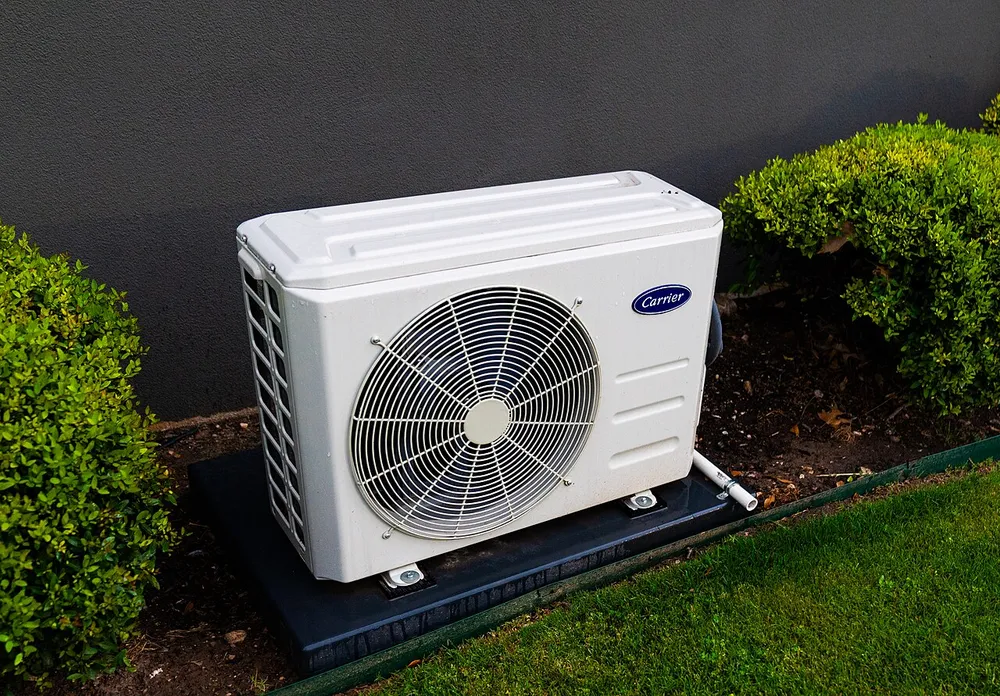
DOE notes that outdoor units should be protected from high winds, which can cause defrost problems, and may need to be elevated because of snow build-up. In heating mode the outdoor coil defrosts and drains meltwater; if that water or drifting snow can't clear the base, ice can build up around the coil. Keep shrubs and fences back so air can flow, and keep the unit away from bedroom windows for noise.
Curated heat pump picks (2)
Two products only: a 2-ton split system for a smaller home or addition, and an inexpensive riser kit that lifts an outdoor unit off wet ground or out of light snow. Prices were checked on the live HVACDirect listings on November 2, 2026 and change often.
- ACiQ 2-Ton 14.3 SEER2 Heat Pump Split System, R32 (AC-I-24HP14 / AC-I-24AH14), $2,549.99 on hvacdirect.com (listed as shipping in 1–2 weeks). The listing shows 23,000 BTU/h cooling and heating at 47°F, 14.3 SEER2, 11.7 EER2 and 7.5 HSPF2, a single-stage compressor, a multi-position air handler (850 cfm max) and optional 5–20 kW heat kits. HVACDirect suggests 1,000–1,300 sq ft, but confirm with a Manual J. As a single-stage, standard-efficiency unit it suits mild-winter and hot climates more than cold ones. Split systems need refrigerant line work, which under EPA's Section 608 rules takes a certified technician. Use code TBZOQ3JUBY0G at checkout.
- 6-Inch Heat Pump Risers (4-Pack, HPR-6), $41.99 on hvacdirect.com. This is the under-$100 pick. The listing describes four risers that raise an outdoor unit 6 inches above standing water and light snow to help defrost water drain, with butyl mastic pads and support for up to 2,000 lb distributed across the set. In heavy-snow areas, ask your installer whether you need a taller stand or wall bracket.
HVACDirect links are affiliate links; use code TBZOQ3JUBY0G at checkout (about 3%; confirm on hvacdirect.com). Ratings and coverage figures are the seller's listing claims; check the AHRI certificate and the manufacturer's installation manual before you buy.
Where this fits in the house
Still deciding between ducted and ductless? Read central AC vs DIY mini-split. Whatever you install, a clean filter protects airflow; see our furnace/AC filter sizes and MERV guide. A heat pump's controls are electronics, so a whole-house surge protector is worth considering, and ceiling fans can let you set the thermostat a little higher in summer. All our HVAC picks are on the Products page.
Bottom line
Size from a Manual J, not square feet. Keep cooling capacity close to the load so the system dehumidifies, check heating output at your design temperature, and decide up front how much backup heat you need and how it's controlled. Then make sure the ducts can move about 400 cfm per ton and the outdoor unit sits where it can breathe and drain.
Sources
- U.S. DOE Energy Saver: Air-Source Heat Pumps (copy of the energy.gov page captured August 2025 and filed with the California PUC; balance point, heat strip controls, airflow per ton, outdoor unit placement)
- CEE/TRC: ASHP Decision Matrix and System Design Guide (hosted by DOE; staged supplemental heat)
- U.S. DOE: Heating and Cooling Equipment Selection fact sheet (avoid rules of thumb, Manual J and S, oversizing and short cycling)
- NEEP: Guide to Sizing & Selecting Air-Source Heat Pumps in Cold Climates (hosted by DOE; no padding, extended performance data, 100–115% vs 75–85% strategies)
- Natural Resources Canada: Air-Source Heat Pump Sizing and Selection Guide (balance point, sizing options, existing duct limits)
- ICC/ACCA: Manual S code verification guidance (heat pump cooling capacity limits)
- ACCA: Correctly sizing variable-capacity heat pump equipment and ACCA: revised Manual S standard
- International Residential Code M1401.3: Equipment and appliance sizing (via UpCodes)
- ENERGY STAR: Air-Source Heat Pumps Key Product Criteria (cold-climate COP and capacity at 5°F)
- U.S. EPA: Section 608 refrigerant management (technician certification)
- HVACDirect listings for the ACiQ 2-ton heat pump system (including heat kit options) and HPR-6 risers: specs and prices (checked November 2, 2026)
Information only; not engineering advice. Have a licensed HVAC contractor perform the load calculation, refrigerant work and electrical connections, and follow local code and the manufacturer's instructions.