
Furnace AFUE explained: 80% vs 96% gas furnaces
Affiliate disclosure: HVACDirect.com is an affiliate partner. Product links below use our affiliate tracking and may earn a commission at no extra cost to you. Use code TBZOQ3JUBY0G at checkout for an affiliate program product discount (about 3%; confirm on hvacdirect.com). We have not hands-on installed these products; specs and prices are summarized from HVACDirect listings as of November 4, 2026. See our affiliate disclosure.
Last reviewed: November 4, 2026.
When you replace a gas furnace, the biggest spec on the quote is AFUE, usually 80% or somewhere in the mid-90s. The higher number saves gas, but the two furnace types are built differently: they vent differently, one makes water you have to drain, and they fit some houses better than others. This guide explains what the rating means, what changes at the install, and what the federal rules say as of November 2026.
1. What AFUE means
ENERGY STAR describes Annual Fuel Utilization Efficiency (AFUE) as, in general, the percentage of the heat in the incoming fuel that becomes space heat instead of being lost. The exact test is in federal rules (10 CFR Part 430, Appendix N). An 80% furnace turns about 80 cents of every gas dollar into heat; a 96% furnace about 96 cents. The ACiQ 96% furnace below shows this on its listing: 60,000 BTU/h of gas input and 57,600 BTU/h of heat output.
AFUE is a seasonal lab rating of the furnace itself. It doesn't count heat lost through leaky ducts in an attic or crawlspace, so a high-AFUE furnace on bad ductwork can still waste energy.
2. Why 90%+ furnaces are "condensing"
A high-efficiency furnace pulls so much heat out of the exhaust that water vapor in the flue gas condenses. That changes three things:
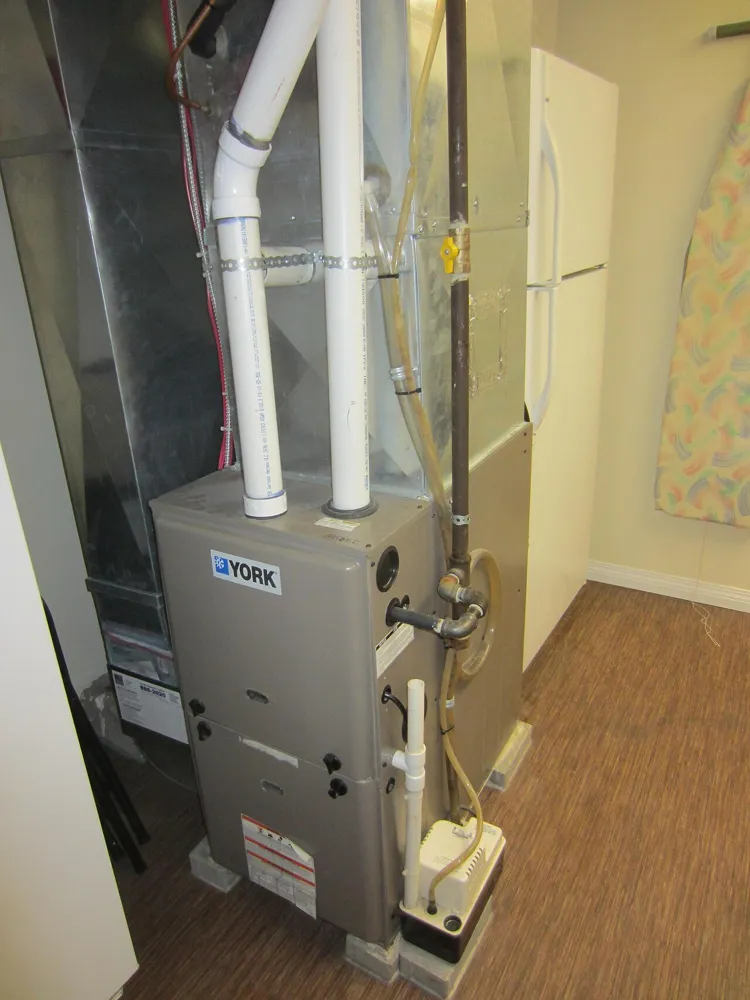
- Venting. HVACDirect notes that furnaces at 90% AFUE and above are condensing units that use PVC venting, typically run out a side wall or roof, instead of the metal flue or chimney an 80% furnace uses. Many draw combustion air through a second PVC pipe.
- Condensate. The furnace makes water, which needs a drain. If there's no floor drain or gravity path nearby, you need a condensate pump.
- Orphaned water heaters. If an 80% furnace shared a chimney with a gas water heater, removing the furnace can leave the chimney oversized for the water heater alone. Ask your contractor to check the remaining vent.
Those extra steps are why a high-efficiency swap can cost more to install than the equipment price difference suggests, especially in a closet or attic far from an outside wall.
3. 80% vs 96%: when each makes sense
On HVACDirect tonight, ACiQ's 60,000 BTU single-stage gas furnace sells for about $1,045 at 80% AFUE and $1,484 at 96%, so the equipment gap is roughly $440 before venting and drain work. Whether that pays back depends on how much you heat:
- Cold winters, long heating season: the 96% unit saves more gas every year and is usually worth it.
- Mild winters, little heating: savings are smaller, so an 80% furnace (where still allowed) or a heat pump may be the better spend.
- Hard-to-vent locations: an interior closet with no route for PVC can make a condensing install difficult; get a quote for both.
To compare annual cost, take last winter's gas use for heating and scale it: switching from 80% to 96% AFUE cuts the gas needed for the same heat by about one-sixth (80 ÷ 96 ≈ 0.83). Size isn't fixed by the old furnace either. A Manual J load calculation, the same method covered in our heat pump sizing guide, often shows an older furnace was oversized.
4. ENERGY STAR levels by region
ENERGY STAR's current furnace criteria require 95% AFUE or higher for gas furnaces in the U.S. South and 97% or higher in the U.S. North, plus air leakage of 2.0% or less. The program lists the states in each region; for example, Texas, Georgia and Arizona are South, while Illinois, Colorado and Pennsylvania are North. A 96% furnace can carry the ENERGY STAR label in Southern states but would not meet the Northern level.
5. The federal minimum and the 2028 rule
Non-weatherized gas furnaces made since November 2015 must meet 80% AFUE. DOE's December 18, 2023 final rule raises the minimum for non-weatherized and mobile-home gas furnaces to 95% AFUE for units manufactured on or after December 18, 2028, which in practice means condensing furnaces. The rule's status is in flux: in 2026 DOE took comment on a gas-industry petition to delay the date, the U.S. Supreme Court vacated a lower-court judgment on the rule and sent the case back, and DOE has said it is reconsidering the standard. As of October 2026 the federal regulation text still lists the 95% level and 2028 date. The rule covers when furnaces are made, not existing furnaces in homes, so nobody has to replace a working 80% unit.
One more change: HVACDirect notes that the federal 25C tax credit ended for equipment placed in service after December 31, 2025, so don't count on it for a 2026 install. Check your utility for rebates instead.
Curated furnace picks (2)
Two products only: a 96% AFUE furnace and an inexpensive condensate pump for installs without a nearby drain. Prices were checked on the live HVACDirect listings on November 4, 2026 and change often.
- ACiQ 60,000 BTU 96% AFUE 9-Speed Single-Stage Gas Furnace, Upflow/Horizontal (AQ-GR9S960603BN), $1,484 on hvacdirect.com (was $1,746). The listing shows 57,600 BTU/h output, PVC venting, a 9-speed ECM blower up to 1,200 CFM, a 17.5″-wide cabinet, ENERGY STAR status and AHRI 215224972, with a lifetime heat exchanger and 10-year parts warranty with registration. Horizontal installs need a drain kit, and propane needs a separate LP conversion kit. Gas, venting and electrical work belong with a licensed contractor. Use code TBZOQ3JUBY0G at checkout.
- 15′ Lift Condensate Pump (CP151UL), $82.99 on hvacdirect.com. This is the under-$100 pick. The listing describes a 1/30 hp pump with a 1/2-gallon ABS tank, three inlet holes, a removable 3/8″ barbed check valve and thermal overload protection, for high-efficiency gas furnaces, air conditioners and condensing boilers. Ask your installer to wire an overflow safety switch so a failed pump shuts the furnace off instead of flooding the floor. Use code TBZOQ3JUBY0G at checkout.
Prices and specs come from HVACDirect listings and can change. Confirm the current price, fuel type and fit before you buy.
Where this fits in the house
Weighing a furnace against a heat pump? Start with our heat pump sizing guide and central AC vs DIY mini-split. Any new furnace needs the right filter; see the furnace/AC filter sizes and MERV guide. A furnace's control board is electronics, so a whole-house surge protector is worth a look. All our HVAC picks are on the Products page.
Bottom line
AFUE tells you how much of your gas becomes heat. A 96% furnace saves the most where winters are long, but it needs PVC venting and a condensate drain or pump, so price the whole install, not just the box. Check ENERGY STAR's level for your region, size from a load calculation, and keep an eye on the 2028 rule if you're planning ahead.
Sources
- ENERGY STAR: Furnaces key product criteria (AFUE definition, 95%/97% regional levels, air leakage)
- Federal Register: Energy conservation standards for consumer furnaces, final rule (Dec. 18, 2023) (95% AFUE, Dec. 18, 2028 compliance)
- U.S. DOE: Consumer furnaces (rulemaking status and 10 CFR 430.32)
- The HVAC Standard: Furnace AFUE ratings, federal minimums and the 2028 rule (2026 petition, Supreme Court order and DOE reconsideration timeline)
- HVACDirect listings for ACiQ 80% and 96% AFUE furnaces, the gas furnace category notes on venting and tax credits, and the CP151UL condensate pump: specs and prices (checked November 4, 2026)
Information only; not engineering or tax advice. Have a licensed HVAC contractor size the furnace and handle gas, venting, condensate and electrical work to local code and the manufacturer's instructions.